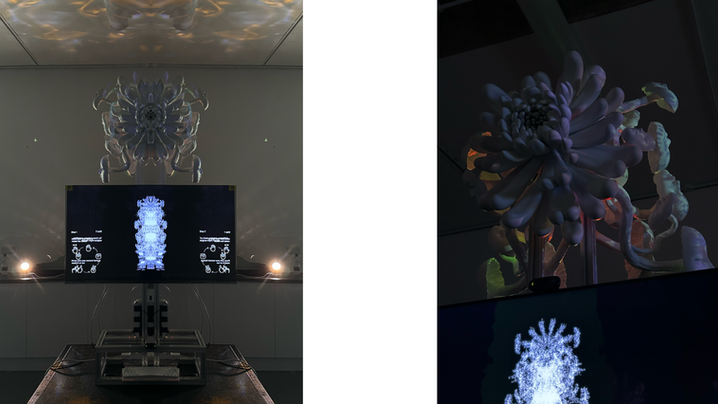
Mantra Fortress
Mantra Fortress is a major creative project that I have developed over the past year, marking a significant turning point in my artistic practice.
This work signifies a transition from 2D animation to 3D, functional, and spatial installation art.
Its central aim is to liberate time-based, image-driven narratives from the screen and transform them into immersive and interactive spatial structures.
Through this transformation, the audience is no longer a mere spectator, but becomes an active participant engaging through body and perception.
The project is rooted in my long-term research interests in ritual, religious culture, traditional Chinese cultural systems, and sacred architectural forms.
While my earlier works expressed visual and symbolic content through digital animation, Mantra Fortress attempts to reinterpret these ideas through spatial language.
By combining 3D printing, mechanical structures, motion-sensing systems, and multimedia projections, the installation constructs a responsive and multilayered environment.
The work consists of several key components — multi-armed sculptures, rotating models, gesture-based interactive animations, and steel spatial frameworks.
Its overall design draws inspiration from the structural logic of fortresses, temples, and fungal networks, forming a dynamic and interconnected system that emphasizes movement, flow, and decentralized organization.
Each component plays a distinct role — for exhibition display, interaction, or narrative and sonic engagement — offering a multidimensional experience for the viewer.
Due to current financial and production constraints, it is difficult to realize the entire installation at full scale.
In response, I have deconstructed the project into multiple media elements and adopted a modular approach — presenting models, interactive projections, and sound systems to construct a fragmented yet immersive environment within the exhibition space.
This modular presentation serves as a practical strategy for spatial storytelling under limited conditions.
Mantra Fortress continues my previous 2D animation practice while functioning as an intermedia and cross-sensory experiment.
Through this work, I aim to dissolve the boundaries between digital imagery and physical space, creating an artistic platform that encourages participation through body, perception, and conscious attention.

2D to 3D
In my artistic practice, the transformation from two-dimensional imagery to three-dimensional space has been both an important area of exploration and a methodological breakthrough. My early works primarily focused on two-dimensional animation, unfolding symbols, images, and narratives through the medium of the screen. This approach allowed for the linear development of visual content and the construction of symbolic systems; however, it was simultaneously constrained by the limitations of flatness and temporality, often rendering the viewer a passive observer.
In recent years, I have become aware that two-dimensional imagery alone is insufficient to fully embody and express the subjects of my inquiry—such as rituality, religious culture, and cosmology. Therefore, I began to liberate the visual narratives once dependent on the screen, transforming them into spatial, tangible, and participatory installations. This shift is not merely a change of technical medium, but rather a fundamental transformation in the logic of creation itself—from “seeing” to “participating,” from a “visual narrative” to a “spatial narrative.”
In this process, I have incorporated methods such as 3D printing, mechanical structures, motion sensing, and multi-channel video to construct spatial environments characterized by hierarchy and interactivity. The audience is no longer a mere spectator, but an active participant engaged through body, senses, and consciousness in the generative process of the work. The linear narrative of two-dimensional imagery expands into a multi-dimensional spatial experience, allowing the work to gain greater immersion and openness.
The practice of moving “from 2D to 3D” thus goes beyond the expansion of form or medium—it signifies a transformation in artistic thinking itself. Through this shift, I aim to break down the boundaries between the virtual and the real, between image and space, and to establish a more direct and profound dialogue between art and its audience.
“Tower-like” Formative Creation Concept
I am envisioning spatially re-constructing the creative results I have achieved so far in the form of a “tower-like” structure. This notion is not merely a formal choice in terms of shape, but derives from the symbolic nature inherent in the archetype of the “tower”. The tower has been an important form in religious and ritual spaces, understood as a symbol mediating between heaven and earth, between humans and the cosmos.
Through the “tower-like” structure, I wish to reorganize the fragments of works that have hitherto been dispersed, in accordance with hierarchies of time, theme and media, vertically layering them and forming an ascending visual narrative. The lower tier represents my point of departure and my enquiries; the middle tier represents the development and deepening of practice; the upper tier symbolises openness and transcendence toward the future. In the course of viewing, the audience will intuitively perceive both the continuity and transformation of my creative trajectory, while also having the experience of “climbing the tower of thought”.
Such a spatial re-arrangement becomes in its entirety a commemorative monument. It is not merely a retrospective of a personal creative history, but an attempt to re-conceive one’s artistic practice within the triple relation of “cosmos–human–spirit”.